

Jura Wine Is Having a Moment, So Why Am I Worried?
My love for the Jura is tainted by fear for this wine region
It may seem that I am obviously following the hype by writing about a natural wine region that, 25 years ago, was known to almost no one, including me, and all of a sudden, there is more demand than the supply can provide. At the time of my learning about wine, I was intrigued by the odd shaped bottles and the wax top sitting on the cork rather than the typical aluminum foil. I can tell you that in my 20s, buying a bottle for $40 seemed out of the question, and I would more likely buy a $9 bottle of Merlot from California. I probably missed a few Overnoy bottles at a tenth of today's price. I have sentimental reasons too for loving this place, as a side of my family comes from its neighbors, Switzerland and Franche-Comté.
I recently saw the Jura in the news, and sometimes it is not for good reasons to be in the headlines, being in the media can always be a double edged sword. I know an immense majority of wine drinkers have been drawn to these fantastic natural wines and prices have been on a constant rise. Despite this revival, this tiny wine region in France has reasons to worry about its future. The deep struggles of climate change have been affecting its growing seasons, with grapes literally burning on the vines. Years ago, this issue was mostly happening in the south of France, in particular in the Rhone and the Languedoc-Roussillon, for the second time in a very long time.
Overall, many different wine regions have been suffering from the recent extreme weather changes, but for the Jura, it is something a little newer, especially to feel a heat wave in these higher elevation terroirs. The Loire in 2024 had terrible weather, but of a completely different kind, with rain and flooding involved, and the harvest was a disaster for a lot of its producers; a few winemakers even ended up giving up on making wine. However, my words about the Jura might need to be taken with a grain of salt, as perhaps I am being overly worried. It is not so much a new phenomenon but rather its depth and impact that have taken a more extreme turn this year.
As the future cannot be predicted I would reckon now is the time more than ever to drink these wines.
Some wines for the Jura we are excited about at Wine Therapy and please keep in mind we only have a few bottles of each:

Photo of Lieu-dit Croix Sarrant in Château-Chalon by VineTrail
Les Dolomies
Cuvée La croix Sarrant 2023.
Husband and Wife team Steve and Celine Gormally started with a tiny plot in 2008 of 0.5 hectare, located in Passenans. The name Dolomies is a reference to the Dolomitic rocks, a salty magnesium limestone. Nowadays, the couple farms 5.5 hectares of vines. Julien Labet from Domaine Labet was a big influence at the beginning of their learning winemaking. Wild yeast fermentation and bottling without fining or filtration have always been their norm. They use tiny amounts of Sulfur for protection (30mg/l total). This is a wine made from the emblematic and unique Savagnin grape, which is one white grape I favor the most. The vines are grown on micro-parcels in Château-Chalon, the wine is celebrated for its bright acidity, low alcohol (around 12.5%), and distinct nutty, savory, and mineral notes; it offers a briny, lemony flavor, making it a beautiful pairing with fish, for example.
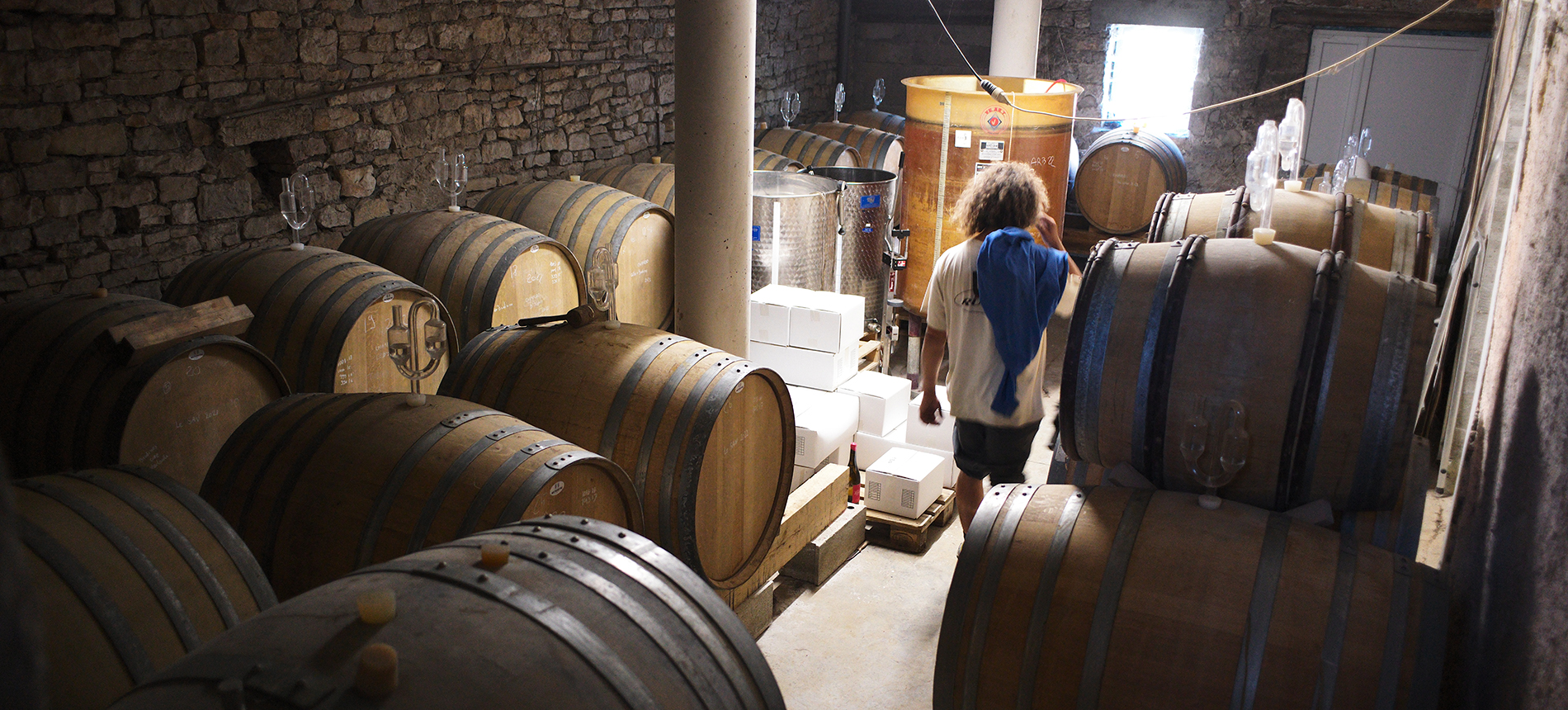 Photo of Julien Crinquand in the Cellar by Polaner Selections
Julien Crinquand
Canons de Jean D’Jopin Chardonnay 2023
Having grown up with an agricultural background, Julien Crinquand apprenticed in his early 20’s with Fabrice Dodane at Domaine de St Pierre, one of the early leaders of the natural wine scene in the Jura. Dodane was a valuable mentor, teaching Crinquand the craft of organic viticulture and careful vinification with little or no added sulfur. With Dodane’s assistance, Crinquand went on to launch his estate in 2019, using the family vineyards, which had already been converted to organic viticulture back in 2016.
D'Jopin is his ouillé Chardonnay, topped up throughout aging to protect it from oxidation and showcase the grape in its purest form. Bright, linear, and intensely mineral, it delivers the hallmark chalky tension and precision that define the Jura. The 2023 vintage is already drinking beautifully but will continue to evolve gracefully over the next several years.
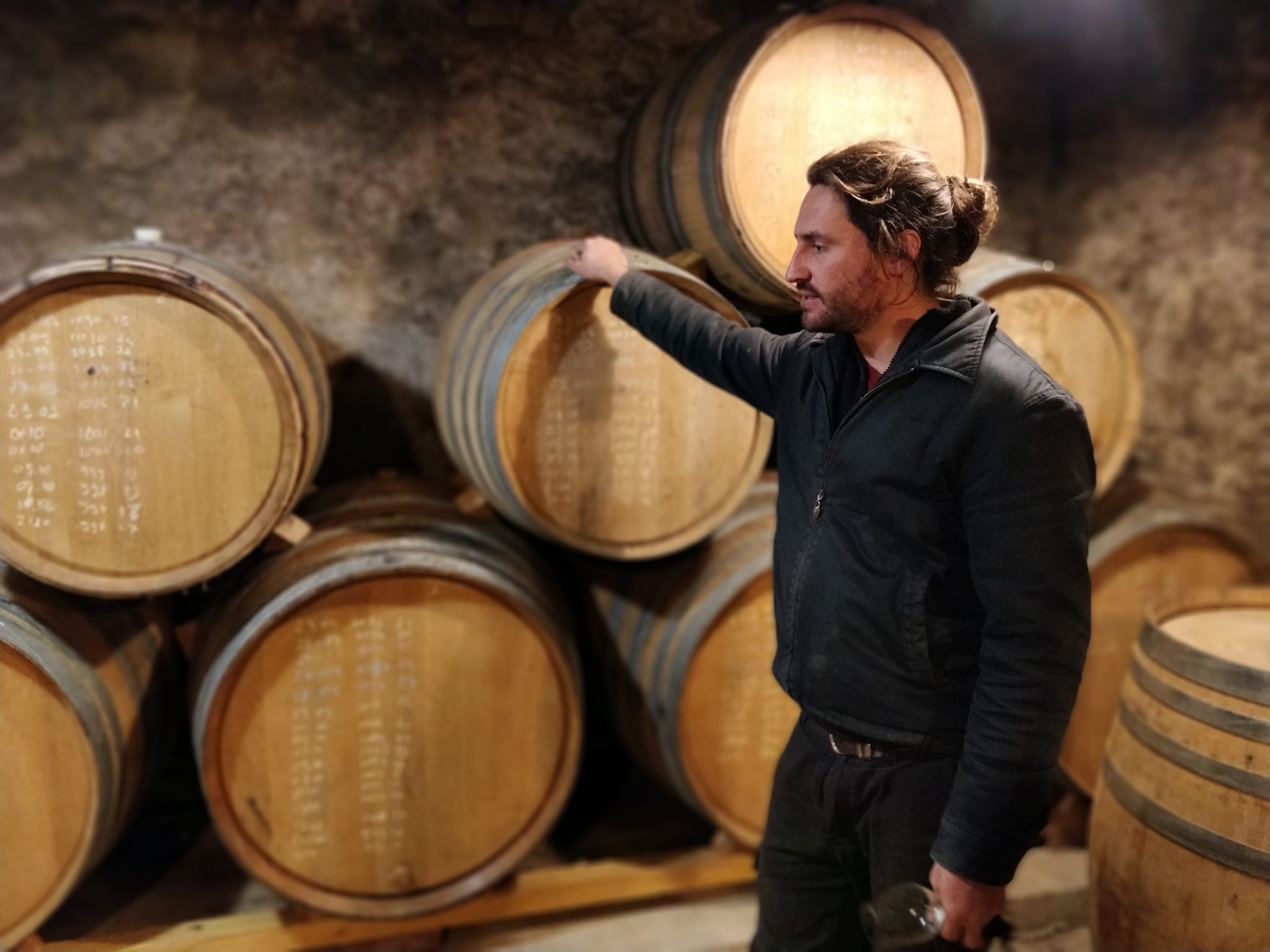
Photo of Nicolas Jacon in his Cellar by Coeur Wine Company
Nicolas Jacob
A native of the Jura, Nicolas Jacob spent his early years working in organic gardens, where he developed a deep appreciation for the natural world and an interest in wine. He went on to train at the legendary Domaine Macle in Château-Chalon before working alongside Jean-François Ganevat in both the vineyards and the cellar. These formative experiences gave him a quiet confidence and a clear sense of purpose that belies his age. In 2015, he purchased his first hectare of vines in L’Étoile, marking the beginning of his own domaine.
In 2019, he expanded the domaine with the acquisition of five additional hectares, spread across a series of small parcels in the southern part of the Jura. Known for his meticulous attention to detail, Nicolas farms according to organic and biodynamic principles, with an unwavering focus on producing fruit of exceptional purity, concentration, and balance—the essential foundation for truly great wines.
Nicolas Jacob Cuvée La Haut Chardonnay 2023
Sourced from the highest and rockiest slopes of L'Étoile, where Chardonnay vines planted in 1953 root deep into limestone soils, La Haut is Nicolas Jacob's purest expression of the appellation. The fruit is directly pressed and fermented spontaneously with indigenous yeasts before spending 18 to 24 months aging in seasoned 600-litre barrels and demi-muids.
Bottled without fining, filtration, or added sulfur, the 2023 is a wine of striking precision and energy. Its layered minerality, crystalline fruit, and remarkable depth make it compelling in its youth, while its structure and balance promise graceful evolution in the cellar for years to come.
Nicolas Jacob Cotes du Jura Poulsard 'Les Chazaux' 2024
Sourced from a 3.5-hectare parcel in Augéa, where Poulsard is planted on classic Jurassic marl soils, Les Chazaux is a beautifully pure expression of one of the region's most distinctive grape varieties. Delicate and translucent in the glass, it opens with lifted aromas of wild strawberry, rose petal, red currant, and damp forest floor.
The palate is light, silky, and remarkably vibrant, combining juicy red fruit with fine mineral tension and a whisper of spice. Ethereal yet deeply expressive, the 2024 captures the finesse, freshness, and understated complexity that have made Nicolas Jacob's wines some of the Jura's most sought-after bottles.
Joseph Dorbon
Joseph Dorbon began his journey as a vigneron in 1996, tending three hectares of vineyards surrounding his home village of Vadans, just six kilometers north of Arbois and across the Route Nationale from the renowned village of Montigny-les-Arsures. His hillside vineyards are southeast-facing and sit at approximately 322 meters (1,000 feet) in elevation, offering ideal exposure and conditions for Jura’s traditional varieties.
Committed to thoughtful, sustainable farming, Dorbon works his vines according to ecological principles and is currently progressing through organic conversion (en conversion biologique). He limits soil disturbance, ploughing only twice a year, with the second pass carried out in June using a horse. Between these interventions, natural vegetation is encouraged between the rows, while cultivation is focused only beneath and around each individual vine.
The domaine’s vineyards are planted predominantly to white varieties, with Chardonnay and Savagnin accounting for around 70% of the vines, alongside traditional Jura reds—Trousseau, Poulsard, and Pinot Noir—which make up the remaining 30%. All grapes are harvested by hand, reflecting Dorbon’s careful, artisanal approach to expressing the character of his terroirs.
Joseph Dorbon Arbois Blanc cuvée des Moyne Vieilles Vignes 2017
Such a wonderful value and complex wine that is almost 10 years old, with the help of eponymous importer Rosenthal Wine Merchant who holds back vintages. This 2017 is just marvelous for the price, Cuvée des Moyne—with moyne being the Middle French spelling of moine, meaning “monk”—comes from an interplanted parcel of 45- to 75-year-old Chardonnay (80%) and Savagnin (20%) vines.
A wine of striking precision and mineral intensity, it reveals vibrant layers of mandarin citrus, saline freshness, and subtle notes of curry leaf and spiced marzipan. A bright, energetic acidity provides structure and lift, carrying the wine through a long, complex finish. A beautifully layered and saline expression of sous-voile aging, this is a captivating Jura white that rewards slow contemplation over several hours.
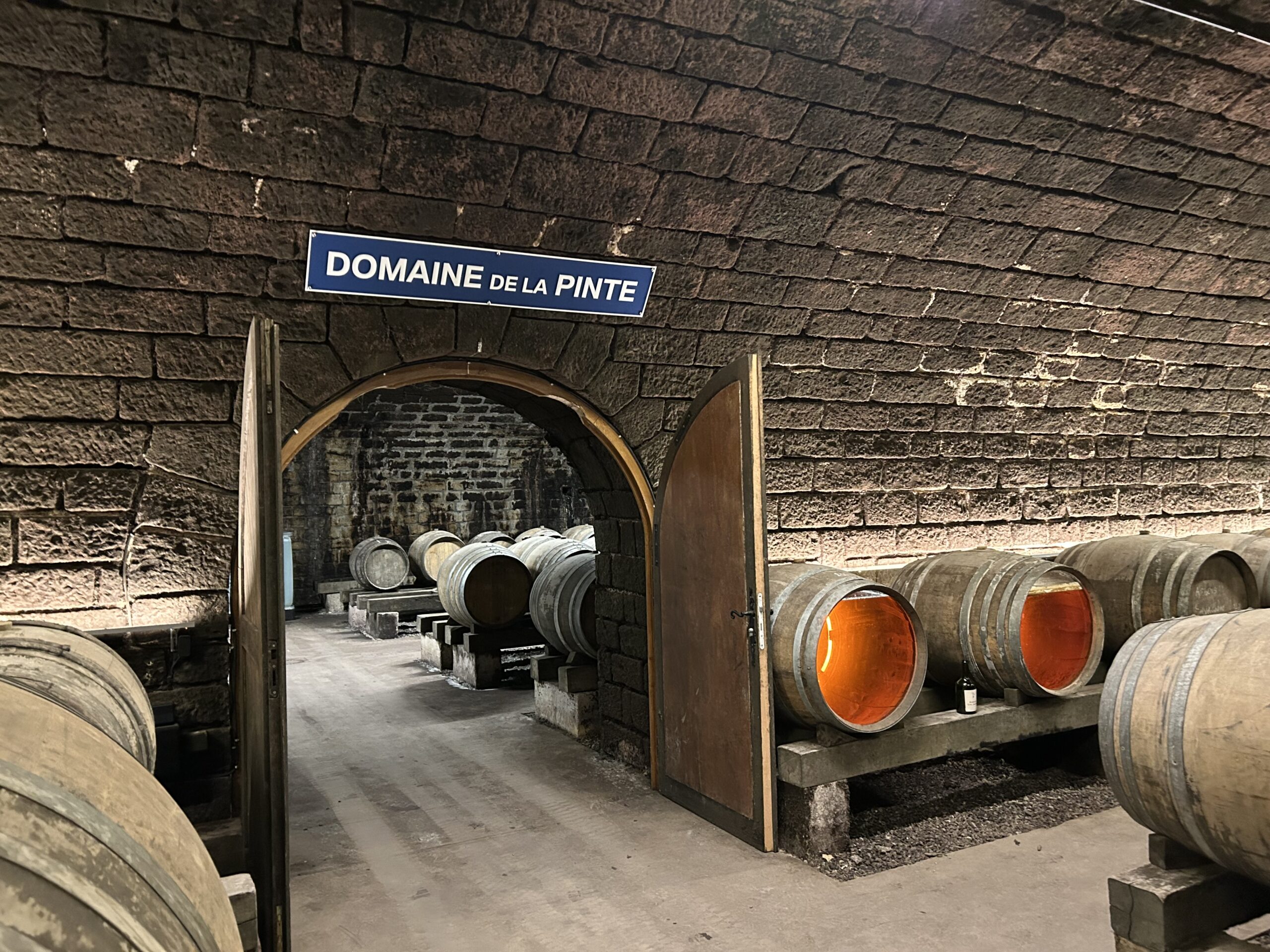
Photo by Domaine de la Pinte
Domaine de la Pinte
At the heart of the Arbois vineyards, Roger Martin helped shape the legacy of Vin Jaune. At the historic site known as La Pinte à la Capitaine, planted on the blue marls of the Lias, he established 14 hectares of Savagnin—the largest Savagnin planting in the region at the time.
Today, his son Pierre Martin continues this pioneering work, expanding the estate to 34 hectares of vines while preserving the family’s commitment to Jura’s traditional varieties and unique terroirs. In 1999, La Pinte made the bold decision to convert its entire vineyard holdings to organic farming, and in 2009 took another step forward by adopting biodynamic practices across the full estate.
They practice shallow plowing which does not destroy the soil, but on the contrary, will contribute to the harmony between each element which composes it: microorganisms, mineral trace elements, and micro fauna.
Biodynamic culture also allows the yeasts to grow on the skin of the grapes. The grapes are harvested by hand and are vinified with these indigenous yeasts. The use of sulfur is limited and not systematic: a little on the juice before starting the fermentation, sometimes during aging.
The fermentation happens in barriques, demi-muids, and foudres, with the duration varying according to the grape variety.
Domaine de la Pinte Trousseau 2023
The grapes are fully destemmed before undergoing a three-week cuvaison, with regular pumpovers and punch-downs to gently extract colour, structure, and depth. Following the completion of malolactic fermentation, the wine is aged for eight months in a 52-hectolitre foudre.
Brilliant ruby red in colour, it offers an expressive bouquet of blackberry and blackcurrant, layered with subtle notes of smoke and sweet spice. The palate shows impressive depth and balance, with refined structure carried by a long, vibrant, and refreshing finish.


